A Likely Story
/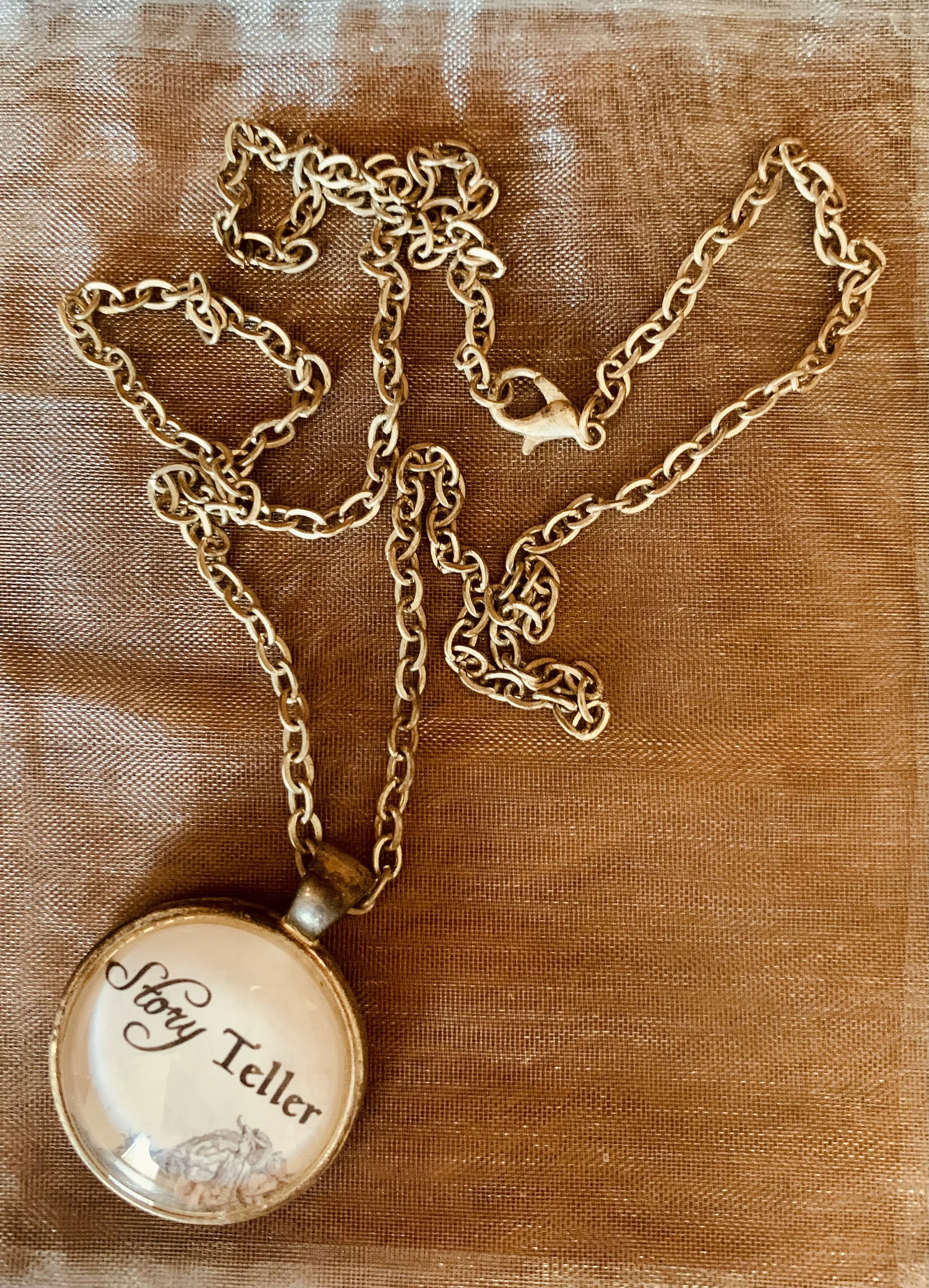
My sister bought me this treasured necklace years ago, not long after my first book was published. It hangs from the bulletin board next to my writing desk, and it serves as both a talisman and a reminder of the essential reason I sit here every day: to tell stories.
When I’m not writing them, I’m cooking up new ones. As a kid, I’d walk to school thinking of myself in the third person: She kicked a stone along the sidewalk as she slowly ate her Pop-Tart. Yup, main character energy, even then. Now, a chance encounter in a grocery store with a stranger has me creating a whole life for the person on my drive home. I can’t help myself.
Here is a story about the young woman who shampoos my hair at the salon: Her name is Alla; she has a Russian accent, and she is tall and willowy with a natural grace. As we chatted, I thought I heard her say “dance,” when I asked if she went to school. By the time she had my head wrapped in a towel, I’d convinced myself she was a hopeful ballerina toiling away in the hair salon so she could someday take the stage. (I mean, I had her costumed and feathered and doing solos at Lincoln Center.) As it turned out, she’d used the word “dense” to describe the traffic on her commute to community college. But some part of me will always think of her as Alla the Ballerina.
My brain is wired to tell stories; it always has been. But it’s getting harder and harder to do that these days. I’m not talking about discoverability, or how many people sign up for my newsletter, or even Amazon algorithms. Sure, that stuff makes reaching an audience more difficult, and of course makes it harder to sell books. But now there are other influences at work making it harder to write books. Are you tired of hearing about AI yet?
I don’t blame you if you are. But this isn’t another lament about how AI is ruining the arts (though it is) or making it increasingly difficult for human authors to convince readers they have warm flesh and a pulse (though it certainly is). I have a simple question for you, gentle reader: Which storyteller to do prefer: me or a machine?
Machines are faster than I am. Machines can write like me, mostly because Big Tech has stolen my work to teach them. Machines can churn out series like your favorites, book after book, supplying you with endless content. Machines don’t have personal lives with demands on their time. They don’t fall ill. And they never get tired or discouraged (as so many of us writers are these days).
Though it’s unfashionable to say aloud, I’m not as young as I used to be. Maybe I’ll run out of stories—or run out of time. More likely, there will come a day when I’m simply too exhausted to fight a culture that doesn’t value what I do. That chooses expediency and economics over human time, sweat, and love. But it’s people, characters who live and breathe on a page, who are at the heart of every good story.
And it’s people who should be telling them.